Scattering-type Scanning Near-field Optical Microscopy (s-SNOM)
Improvements on s-SNOM including 3D response collection, broadband infrared sources, and low repetition rate laser compatibility.
What is s-SNOM?
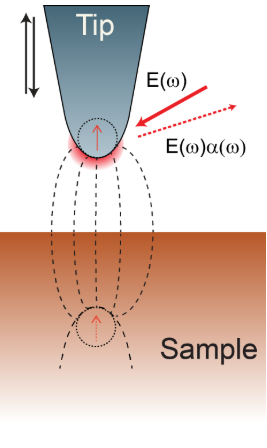
s-SNOM stands for Scattering-type Scanning Near-field Optical Microscopy. It is also known as Apertureless NSOM. It detects the scattered light from the vicinity of a sharp metallic tip that depends on the dielectric functions of sample materials underneath. s-SNOM bypasses Abbe's diffraction limit and is particularly useful for chemical and spectroscopy imaging when paired with infrared light sources.
The initial concept of s-SNOM was proposed by Edward H. Synge in 1928. The modern s-SNOM instrument has been developed since the 1990s based on tapping mode AFM and optical detection of scattered light.
The basic idea of s-SNOM is to detect the change of the scattered light by the tip when the tip-sample distance is modulated by the tapping mode AFM. In a typical s-SNOM operation, a lock-in amplifier demodulates the interferometrically detected optical signal at non-fundamental harmonics of the AFM cantilever oscillation frequency. The demodulation signal is co-registered with the lateral positions of the AFM tip to form an s-SNOM image with a resolution determined by the radius of the tip, rather than the wavelength of the light.
An example of s-SNOM operation is described in literature J. Phys. Chem. A, 2013, 117, 3348. Our research group worked on s-SNOM between 2015 and 2018, developing several key improvements.
s-SNOM with Reconstruction of Vertical Interactions
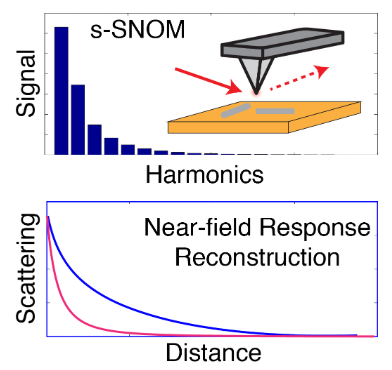
s-SNOM with the tapping mode AFM usually uses lock-in detections and only one of the demodulation harmonics is utilized to form the near-field image. What if all available lock-in demodulation signals are used? In this work, we perform Fourier synthesis on the lock-in signals to reconstruct the vertical near-field interaction along the coordinate of tip-sample distance.
It reveals a missing aspect of tapping mode s-SNOM, and permits a three-dimensional collection of near-field responses. For more details see Nature Communications 6:8973 (2015) and AIP Advances 7, 055118 (2017).
Laser-Driven Plasma Source for s-SNOM
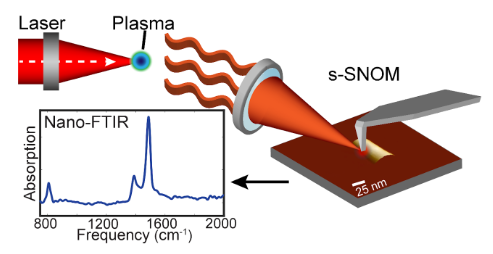
s-SNOM detects the linearly scattered light. The bandwidth of the light source determines the frequency that s-SNOM can operate. Current broadband infrared lasers from the difference frequency generation (DFG) of ultrafast lasers are expensive and bandwidth-limited.
In this project, we incorporated a laser-driven plasma source that provides ultrabroad frequency coverage, high brilliance compared with a regular black body source, and spatial coherence, at a low cost for s-SNOM. It utilizes the technique of nano-FTIR, a variation of s-SNOM for spectroscopy. For more information, see our publication in ACS Photonics, 5, 4, 1467 (2018).
Phase Domain Sampling for Low Repetition Rate Lasers
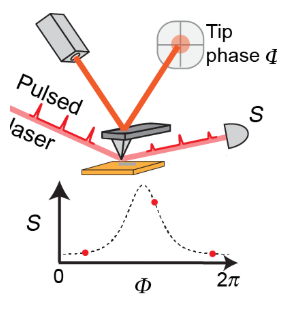
We have figured out a way to combine low repetition rate pulsed laser with s-SNOM. Currently, s-SNOM requires either a continuous wave laser source or a high repetition rate pulsed laser. Pulsed laser sources with a repetition rate below 100 kHz are unable to be used for regular s-SNOM due to the limitation of Nyquist-Shannon theorem on sampling rate.
Our phase-domain sampling technique bypasses this limitation by acquiring near-field interaction responses from a different but equivalent perspective in the phase domain of AFM cantilever oscillations. This technique opens the door to combining s-SNOM at low or irregular repetition rates. For more information, see our paper in Nature Communications 7:13212 (2016).
Key Features
- Reconstruction of vertical near-field interactions
- Three-dimensional response collection
- Laser-driven plasma broadband source
- Low repetition rate laser compatibility
- Phase domain sampling technique
- Nano-FTIR spectroscopy capability
Applications
- Chemical imaging at nanoscale
- Spectroscopy beyond diffraction limit
- Broadband infrared nanoscopy
- Polariton physics studies
- Material dielectric characterization
- Ultrafast laser near-field studies
Key Publications
View All Related PublicationsPolarization‐Engineered Near‐Field Generation Using a Hybrid Tip–Antenna System
Zhenbing Dai, Xinzhong Chen, Zijian Zhou, Lukas Wehmeier, Xiaoji G. Xu, and Mengkun Liu
View Publication →Surface and Volume Phonon Polaritons in Boron Nitride Nanotubes
Cassandra Phillips, Leonid Gilburd, Xiaoji G. Xu, and Gilbert C. Walker
View Publication →