AFM-Based 2D Infrared Spectroscopy (AFM-2DIR)
Action-based time-domain 2D infrared nanospectroscopy bypassing the Abbe diffraction limit.
Motivation
Advances in infrared (IR) spectroscopy have focused on improving spatial resolution and expanding the spectroscopic information that can be obtained. When exposed to light, the sharp metal-coated tip of an atomic force microscope (AFM) localizes and enhances the optical field underneath the tip, making the spatial resolution independent of the incident wavelength. Exploiting the benefits of tip enhancement, atomic force microscopy-based instruments for super-resolution IR imaging have been created, including scattering-type scanning near-field optical microscopy (s-SNOM) with optical detection and AFM-IR microscopy (including the PFIR microscopy) with photothermal mechanical detection.
Meanwhile, the development of time-domain two-dimensional IR (2DIR) techniques, which involves the sequential emission of precisely timed femtosecond IR pulses, has provided intricate spectroscopic information on molecular interactions, such as anharmonicities and coupling of vibrational modes of molecules and energy transfer. However, the spatial resolution of 2DIR is usually restricted by Abbe's diffraction limit. Merging the tip-enhancement of AFM with 2DIR could enable Abbe's diffraction limit to be surpassed, allowing for nanoscale spatial resolution, while also offering the rich spectroscopic information like that of 2DIR spectroscopy.
Our Solution: AFM-2DIR Spectroscopy
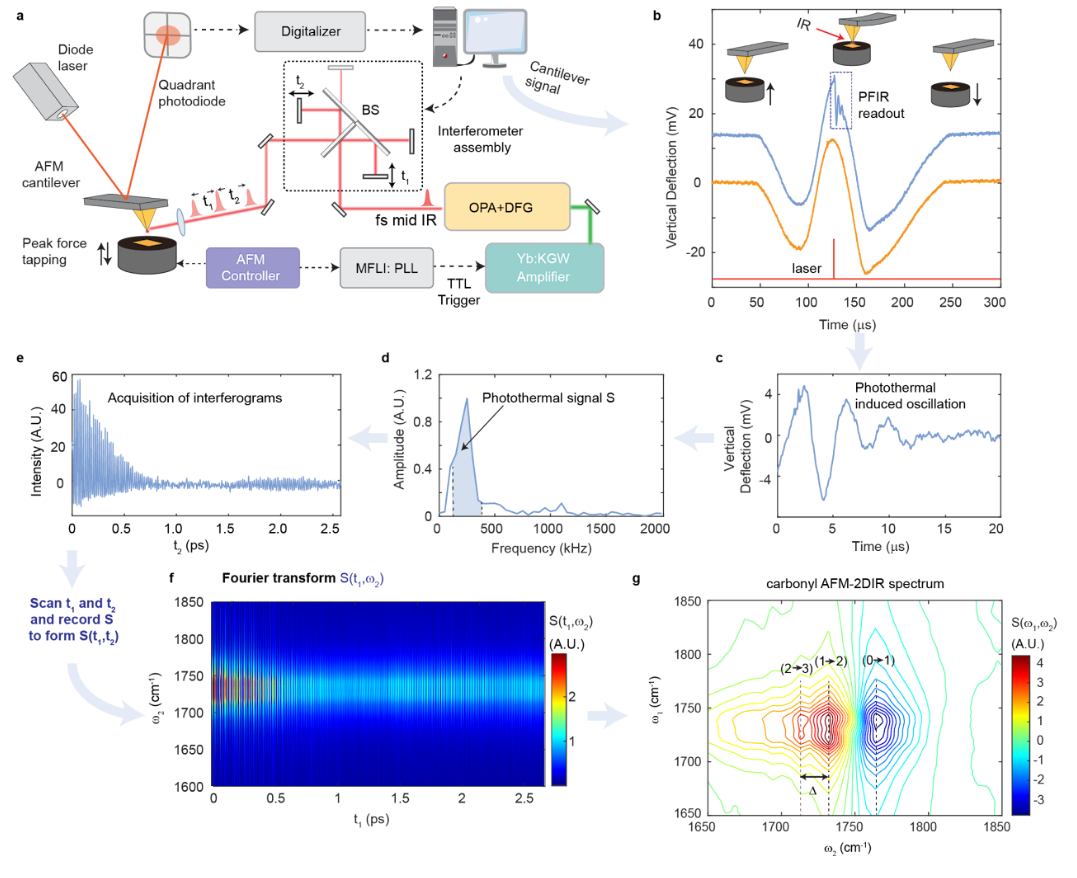
In the AFM-2DIR spectroscopy, we employ the tip-enhancement of a metallic AFM probe to localize the IR radiation from a femtosecond IR pulse sequence and perform photothermal detection. It turns out the photothermal responses of the sample that contains IR resonances depend on the timing between the pulses in the pulse sequence. As a result, if we scan the timing of the pulses and collect the photothermal signal from the AFM (e.g., through the PFIR technique), then we can collect a series of interferograms.
Sequential Fourier transfers of these collective interferograms along two time delays of the IR pulse sequence yield the 2DIR-type of signals. This process is analogous to the optically detected 2DIR spectroscopy, albeit the signal transduction is from the AFM tip's mechanical response and originates from an area much smaller than the optical diffraction limit. In other words, AFM-2DIR is a type of 2DIR that is not restricted by Abbe's diffraction limit.
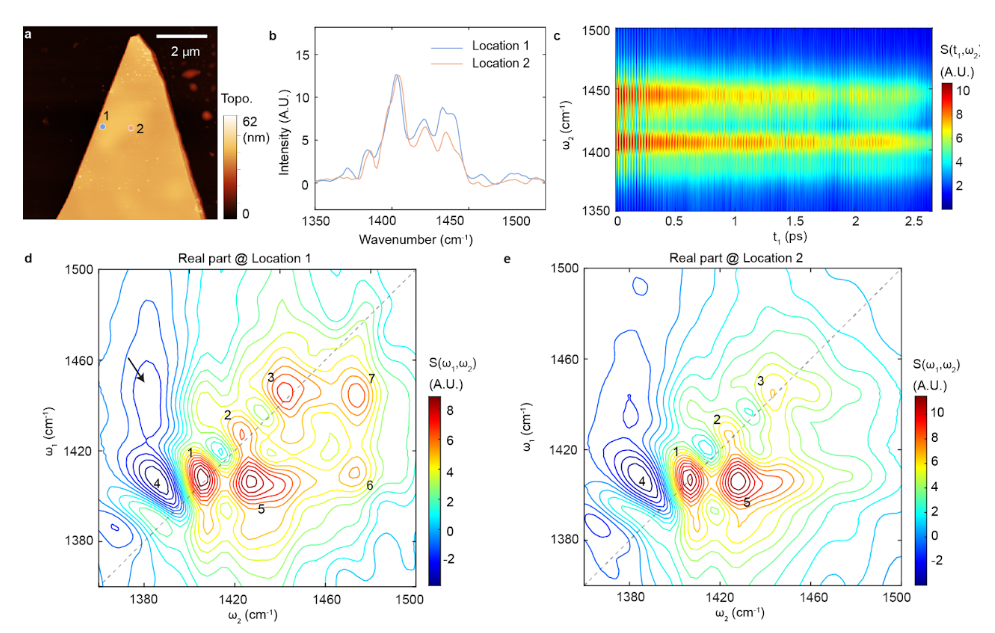
Its spatial precision is AFM-like, which is 10~20 nm. We demonstrated the AFM-2DIR on a model system, such as carbonyl modes, revealing ground state depletion and excited state absorptions.
Key Features
- Time-domain 2D IR spectroscopy
- Nanoscale spatial resolution
- Molecular dynamics information
- Vibrational coupling analysis
- Ultrafast time resolution
- Beyond diffraction limit imaging
Applications
- Protein structure studies
- Molecular coupling analysis
- Energy transfer dynamics
- Chemical reaction monitoring
- Heterogeneous catalyst studies
- Polymer chain dynamics
Key Publications
View All Related PublicationsAction-Based Two-dimensional Infrared Spectroscopy on the Horizon
Qing Xie and Xiaoji G. Xu
View Publication →Atomic-force-microscopy-based time-domain two-dimensional infrared nanospectroscopy
Qing Xie, Yu Zhang, Eli Janzen, James H. Edgar, and Xiaoji G. Xu
View Publication →